Strategy of the State Government of Mecklenburg-Vorpommern for cooperation in the Baltic Sea region
The development of the state of Mecklenburg-Vorpommern is in many ways linked to the Baltic Sea region

The development of the state of Mecklenburg-Vorpommern is in many ways linked to the Baltic Sea region. In addition to the well-known challenges such as the transition to a climate-friendly economy, the changes brought about by demographic change and digitalisation, the Russian attack on Ukraine has raised fundamental questions of security and a secure and sustainable energy supply.
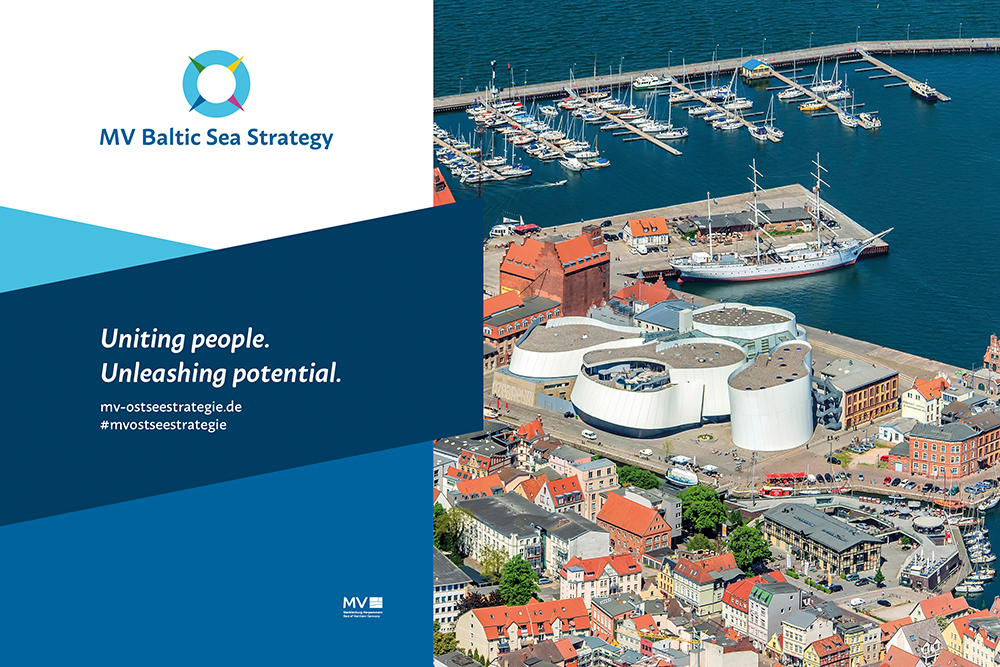
The state government of Mecklenburg-Vorpommern responded to these changes and adopted its strategy for cooperation with the democratic Baltic Sea region on 16 January 2024 ("MV Baltic Sea Strategy").
In the strategy, shared values such as democracy and the rule of law, the respect for human rights and personal freedom are emphasised as the basis for cooperation. The state government's overarching goal is to develop the Baltic Sea region into a European model region for innovation, sustainability and resilience together with the democratic countries bordering the Baltic Sea.
The strategy builds on numerous and long-standing collaborations in the fields of business, science, education, arts and culture, sports, youth and numerous activities in the context of civil society exchange, twin city cooperation and regional partnerships.
Strategy of the State Government of Mecklenburg-Vorpommern for cooperation in the Baltic Sea region (shortened version)
Introduction
Mecklenburg-Vorpommern's close ties to the democratic Baltic Sea region and the cooperation that is practised there, e.g. in regional partnerships, have helped the state to develop into an innovative, competitive region. With its ports and harbours, good infrastructure, sustainable energy production, innovative healthcare industry and internationally acclaimed maritime research, Mecklenburg-Vorpommern today provides important prerequisites for further close cooperation in the Baltic Sea region.
The cooperation partners in the democratic Baltic Sea region are jointly facing major challenges
The changed geopolitical situation and the urgent need to transition to a climate-neutral and sustainable economy require all the states and regions in the democratic Baltic Sea region to make significant adjustments within a very short space of time. In addition to these transformation efforts, there are other major challenges: protecting the Baltic Sea environment, dealing with the consequences of demographic change, securing public services generally, especially in rural areas, medical care and in the field of nursing care, the future-oriented development of digitization and the safe use of artificial intelligence (AI), to name just a few.
State Government is focussing on even closer cooperation with its partners
To manage these processes, the State Government is focussing on even closer cooperation with its partners in the democratic Baltic Sea region. It is convinced that many of the tasks that lie ahead can be accomplished better and faster together.
In pursuing this goal, the State Government can rely on very active, broad-based and cross-level cooperation with the Baltic Sea region with the participation of Mecklenburg-Vorpommern.
Cooperation is reflected in the regional partnerships, in reciprocal visits and projects and through participation in various formats
At a political level, cooperation is reflected in the regional partnerships with the voivodeships (provinces) of West Pomerania, Pomerania and Southwest Finland, in reciprocal visits and projects and through participation in various formats, such as the Helsinki Commission, the CRPM (Conference of the Peripheral Maritime Regions of Europe), the Baltic Sea Parliamentary Conference and the Southern Baltic Sea Parliamentary Forum.
Development of the cross-border metropolitan region of Szczecin, which is to radiate into the southern Baltic Sea region, has been a strategic goal of the State Government for some years.
With this strategy, the State Government is consolidating its priorities and activities. At the same time, it offers an orientation framework for those players in Mecklenburg-Vorpommern who are active in the Baltic Sea region and who are supported by the State Government wherever possible.
The view of the future
The State Government is pursuing the political goal of developing the Baltic Sea region together with its partners into a peaceful, free and innovative model region with strong democratic coexistence, participation and equality.
From the state's point of view, cooperation should focus more strongly on key areas of action in future and aim to accelerate joint solutions in particularly high-priority areas. The overarching objectives will therefore be underpinned by strategic measures.
Strengthening Mecklenburg-Vorpommern as a region that is friendly and keen to cooperate
Cooperation can only succeed if there are enough players who are willing and able to do so. The State Government is therefore also focussing on Mecklenburg-Vorpommern itself. In this way, the intercultural competences in the state are to be strengthened. A particular focus is on the younger generation. In terms of strengthening an open and pluralistic society and cohesion in the Baltic Sea region, the topic of women's rights and gender equality also plays a role as one of the fundamental pillars of the European family.
Protecting the Baltic Sea and promoting a healthy environment for us to live in
Protection of the Baltic Sea and the promotion of a healthy and liveable environment have long been important goals of the state's Baltic Sea cooperation.
The EU has set itself the ambitious goal of becoming climate-neutral by 2050, and Mecklenburg-Vorpommern aims to achieve this goal by 2040. This process offers many opportunities for the state: To implement the European Green deals, Mecklenburg-Vorpommern aims to coordinate its activities more closely with the regions in the Baltic Sea region and promote the democratic Baltic Sea region as a model for the green transformation of the economy and society.
Securing future viability and prosperity
The Baltic Sea region is considered one of the most innovative and competitive regions in the world. The states located around the Baltic Sea can benefit even better from this dynamic background through mutual learning, the exchange of knowledge, innovations, in particular in the field of digitization, the safe use of artificial intelligence and taking into account the needs of rural areas, and the expansion of economic and scientific cooperation
The State Government's action plan
On the basis of the aforementioned goals, the State Government has identified the following measures, which are to be prioritized for implementation by the State Government itself.

1. Strengthening Mecklenburg-Vorpommern as a region that is friendly and keen to cooperate
- Increasing the visibility of the state as a cooperation partner in the Baltic Sea region
- Combining resources and potential in Mecklenburg-Vorpommern to boost cooperation in the Baltic Sea region and develop the region more effectively
- Making Baltic Sea cooperation in Mecklenburg-Vorpommern more visible
- Increased focus of European schools and student exchanges to concentrate on the democratic Baltic Sea region
- Strengthening civil society encounters with a focus on youth and sport
- Further expanding cooperation in culture and art
- Developing an exchange of ideas on women's and gender equality policy issues in the Baltic Sea region

2. Further development cooperation for a healthy environment worth living in
- Establishment of a federal centre of excellence for unexploded ordnance in the Baltic Sea
- Developing resource-conserving and organically based management systems
- Involving the public in Baltic Sea-related research and programmes

3. Securing future viability and prosperity
- Expansion of offshore wind energy and cross-border grid linking
- Development of a regional hydrogen infrastructure
- Coordination of maritime spatial planning and common standards in the Baltic Sea region
- Strengthening transport links to the Baltic Sea region
- Promoting foreign trade links
- Targeted expansion of cooperative relationships in the healthcare industry
- Opening up the “Digital Innovation Space MV” for the Baltic Sea region
- Modernizing administration activities through the use of artificial intelligence
- Increasing the state's attractiveness for students with an international background
Input from the MV cooperation council for the democratic Baltic Sea region

The MV cooperation council for the democratic Baltic Sea region presented its recommendations
© StK M-V
The MV cooperation council for the democratic Baltic Sea region presented its recommendations
© StK M-V
16 recommendations for actions and 56 concrete proposals for measures
The strategy was developed under the leadership of the Ministry of Science, Culture, Federal and European Affairs of Mecklenburg-Vorpommern in close coordination with the State Chancellery and the line ministries.
This process was built on the recommendations of the „MV Cooperation Council for the Democratic Baltic Sea Region“ that was established on May 31, 2022. This advisory body consists of 29 experts from science, education, business, associations, sports and culture, chaired by Bettina Martin, Minister for Science, Culture, Federal and European Affairs, and Prof. Dr. Anja Mihr, Head of the Center on Governance through Human Rights of the Berlin Governance Platform. It developed 16 recommendations for action and 56 concrete proposals for measures, which were presented to Minister President Manuela Schwesig on May 25, 2023, and which were included to a large extent into the MV Baltic Sea Strategy.
Contact
Further information on Baltic Sea cooperation in Mecklenburg-Vorpommern
- MV Baltic Sea Strategy - Strategy of the State Government of Mecklenburg-Vorpommern for cooperaton in the Baltic Sea Region (PDF, 2.95 MB) The long version of the document comprises 20 pages
- Recommendations of the Co-operation Council to the State Government of Mecklenburg-Vorpommern for a State Strategy for Co-operation in the democratic Baltic Sea region (PDF, 1.25 MB) The document comprises 19 pages.
- MV Baltic Sea Strategy To the homepage (in German)